
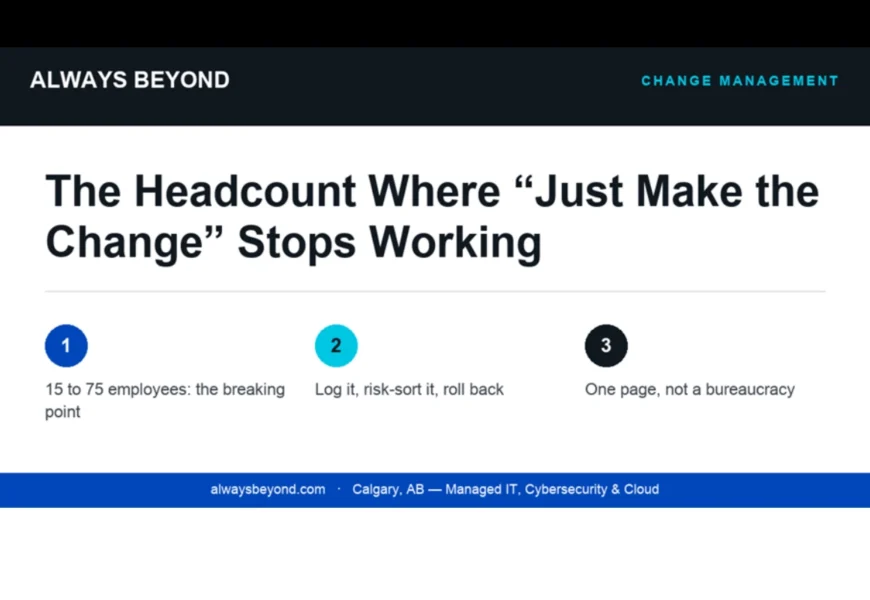
Somewhere between fifteen employees and seventy five, almost every company hits the same invisible wall. Nobody sends a memo about it. The way the business has always made IT changes just quietly stops working, and usually nobody notices until the week something breaks for no obvious reason.
That “way we’ve always done it” is rarely a process at all. Someone decides a change is needed, someone makes it, and everyone finds out whether it worked by whether anything stopped working afterward. That’s not IT change management, that’s the absence of it, and it scales about as well as you’d expect, which is to say it doesn’t.
What the term actually means, minus the jargon
IT change management is a controlled way of rolling out changes, new software, server updates, permission changes, without breaking whatever was already working fine. Strip away the consultant-speak and it answers four plain questions before a change happens: what’s changing and why, who needs to know beforehand, what’s the plan if it goes sideways, and who confirms afterward that it actually worked. None of that requires heavy process, just someone willing to ask those four questions instead of skipping straight to “just do it and see.”
Why nobody notices the wall coming
At a handful of employees, one or two people hold the entire IT setup in their heads, so a change getting made and a problem getting caught happen in the same brain. That breaks quietly as headcount grows. More people touch systems, a new hire, an outside vendor, a second contractor, and no single person has the full picture. A change to one thing, a firewall rule, a shared login, ripples into effects nobody predicted, made by people who wouldn’t notice something break three departments away.
A few patterns repeat in companies that have outgrown ad-hoc changes. A firewall rule gets adjusted to fix one problem and quietly opens access somewhere it shouldn’t. A software update rolls out company-wide on a Friday, and the help desk spends Monday fielding the same broken-login ticket over and over. Two people edit the same system in the same week, neither aware the other touched anything. An employee who left months ago still has access to a shared drive, because offboarding never made anyone’s actual checklist.
None of these is a dramatic failure by itself. They add up to outages and security gaps nearly impossible to trace back to a cause, because there’s no record of what changed or when. That’s the real cost, not the individual incident, but the fog that builds around what state your systems are actually in.
A process light enough that people will actually use it
Nobody needs full enterprise ITIL bureaucracy in a forty person company, that gets abandoned within a month because it’s slower than the problem it claims to solve. A lighter version keeps the same principles at a fraction of the overhead.
- Log the change before it happens: a shared document or simple ticket noting what’s changing, why, and when.
- Classify it by risk. A password reset doesn’t need the scrutiny of a server migration, so sort into low, medium, and high, and only slow down for the ones that earn it.
- Pick a low-traffic window for anything risky, evenings or weekends, not the middle of a Tuesday.
- Have a rollback plan ready before you start, not one improvised mid-crisis.
- Check back a day or two later to confirm the change is still holding.
That’s the whole process. It fits on one page and scales from a two-person IT team to a much larger one without being reinvented every time the company grows.
| Ad-hoc changes | Lightweight change management | |
| Who knows about a change | Whoever made it | Anyone who checks the log |
| Response if it breaks | Reactive, after someone notices | Rollback plan ready in advance |
| Risk sorting | None, every change treated the same | Low, medium, high risk tiers |
| Timing | Whenever it’s convenient | Scheduled around business impact |
Always Beyond, a Calgary-based IT provider, builds this kind of lightweight structure into how it works with growing clients: it’s cheaper to build the habit early than untangle an outage after the fact.
If your company has outgrown the point where one person holds the whole IT picture in their head, that’s the signal. Don’t build the whole system at once. Pick the single step of logging the change before it happens, get that one to stick, then add the rest.