
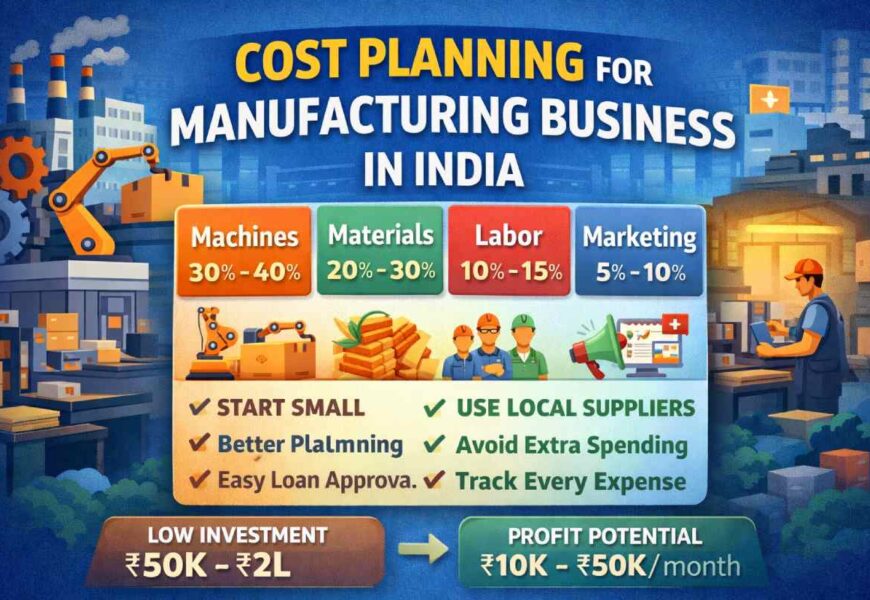
Introduction
Let me be very real with you.
Most people don’t fail in business because of lack of ideas.
They fail because they don’t understand the cost.
They either:
- underestimate expenses
- or invest in the wrong place
And then money runs out.
That’s why before starting any manufacturing business, you must clearly know: Before starting, explore manufacturing business ideas in India.
How much money is needed
Where you will spend
What is necessary and what is not
In this guide, I will break everything in simple words so you can plan better and avoid mistakes.
Why Cost Planning is Important
| Reason | Explanation |
| Avoid Loss | Prevent overspending |
| Better Planning | Clear budget control |
| Easy Loan Approval | Banks trust clear plans |
| Profit Calculation | Know your margins |
You can also check MSME official guidelines for latest business support and rules.
Main Cost Breakdown
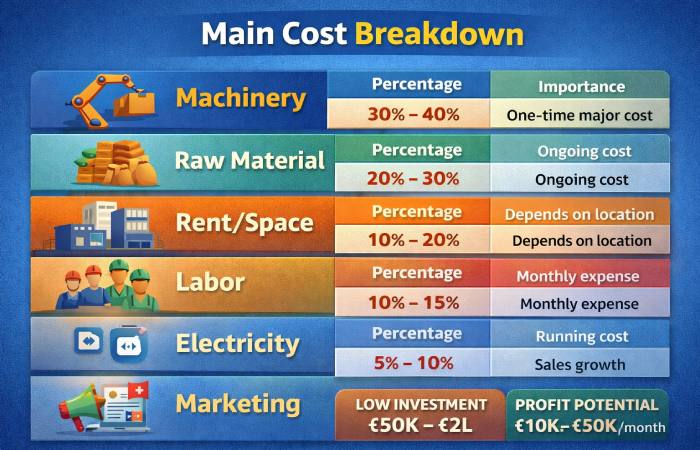
| Cost Type | Percentage | Importance |
| Machinery | 30% – 40% | One-time major cost |
| Raw Material | 20% – 30% | Ongoing cost |
| Rent/Space | 10% – 20% | Depends on location |
| Labor | 10% – 15% | Monthly expense |
| Electricity | 5% – 10% | Running cost |
| Marketing | 5% – 10% | Sales growth |
1. Machine Cost (Biggest Investment)
Machines are the backbone of manufacturing.
Estimated Cost
| Business Type | Machine Cost |
| Small | ₹20K – ₹1 Lakh |
| Medium | ₹1L – ₹10L |
| Large | ₹10L+ |
What affects machine cost?
- Type of product
- Manual or automatic machine
- Production capacity
Simple Advice
Start with:
- small machine
- upgrade later
Many beginners make mistake by buying expensive machines.
2. Raw Material Cost
This is a continuous expense.
Example
| Business | Raw Material |
| Soap | Oil, chemicals |
| Food | Spices, grains |
| Paper bag | Paper rolls |
Cost Range
- 20% to 30% of total budget
Real Tip
Buy in bulk → reduce cost → increase profit
3. Rent and Workspace Cost
You don’t always need a big factory.
Cost Range
| Location | Rent |
| Small town | ₹5K – ₹15K |
| City | ₹15K – ₹50K |
| Industrial area | ₹20K+ |
Smart Strategy
- Start from home (if possible)
- Use small space initially
Learn basics from how to start a manufacturing business in India.
4. Labor Cost
Workers are needed depending on your scale.
Monthly Cost
| Workers | Cost |
| 1–2 workers | ₹10K – ₹25K |
| 3–5 workers | ₹25K – ₹60K |
| 5+ workers | ₹60K+ |
Tip
- Start with minimum workers
- Train them instead of hiring expensive staff
5. Electricity and Utility Cost
Machines need power.
Cost Estimate
- ₹2K – ₹20K/month
Tip
- Use energy-efficient machines
- Reduce wastage
6. Marketing Cost (Most Ignored)
Many people don’t spend here and fail.
Cost Range
- 5% – 10% of budget
Where to spend?
- Social media
- Local shops
- Online selling
Learn selling with how to start an e-commerce business in India.
Total Cost Example
| Expense | Cost |
| Machine | ₹50,000 |
| Raw Material | ₹20,000 |
| Rent | ₹10,000 |
| Labor | ₹15,000 |
| Other | ₹5,000 |
| Total | ₹1,00,000 |
Cost vs Profit Understanding
| Investment | Expected Profit |
| ₹50K | ₹10K – ₹20K/month |
| ₹1L | ₹20K – ₹50K/month |
| ₹5L | ₹50K – ₹1L/month |
For better planning, explore profitable business ideas in India
Low vs Medium vs High Cost Comparison
| Type | Investment | Risk | Profit |
| Low | ₹50K–₹2L | Low | Medium |
| Medium | ₹2L–₹10L | Medium | High |
| High | ₹10L+ | High | Very High |
How to Manage Cost Smartly in Manufacturing Business
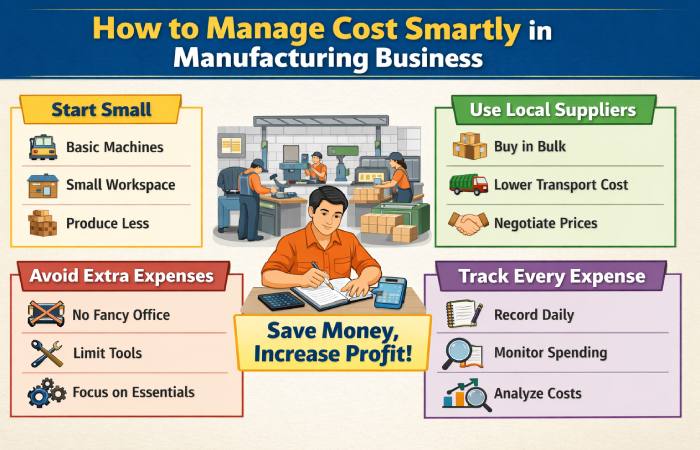
Managing cost is one of the most important parts of any manufacturing business.
Many people think profit comes from selling more.
But in reality, profit comes from controlling expenses.
If you manage your cost properly, even a small business can become profitable.
1. Start Small
Don’t try to do everything in the beginning.
Many beginners make this mistake:
They invest all their money at once — big machines, big space, more workers.
This creates pressure.
Better approach:
- Start with a small setup
- Use basic machines
- Produce limited quantity
Once you understand the market and demand, then slowly expand.
Simple idea:
Start small → Learn → Grow
2. Use Local Suppliers
Raw material cost can affect your profit a lot.
If you buy from expensive suppliers, your cost increases and profit decreases.
Smart way:
- Find local suppliers in your area
- Compare 2–3 vendors before buying
- Build long-term relationship
Local suppliers also help in:
- quick delivery
- lower transport cost
Real tip:
Buying in bulk from trusted local suppliers reduces cost over time.
3. Avoid Unnecessary Expenses
In the beginning, every rupee matters.
Many people spend money on things that are not needed:
- expensive office setup
- extra decoration
- too many tools
This increases cost without increasing profit.
Better focus on:
- machines
- raw materials
- basic setup
Everything else can come later.
Simple rule:
If it does not help production or sales, avoid it.
4. Track Every Expense
This is where most small businesses fail.
They don’t track where money is going.
At the end of the month, they don’t know:
- how much they spent
- how much they earned
Simple solution:
- Write all expenses daily
- Use a notebook or mobile app
- Check weekly or monthly
This helps you:
- control waste
- identify extra spending
- improve profit
Real insight:
Small savings every day become big profit over time.
Quick Summary
| Strategy | Benefit |
| Start Small | Reduces risk |
| Local Suppliers | Lower cost |
| Avoid Extra Spending | Saves money |
| Track Expenses | Better control |
Cost management is not about cutting everything.
It is about spending money in the right place.
A smart business owner:
- spends carefully
- tracks money
- improves step by step
If you follow these simple steps, your manufacturing business will stay stable and grow faster.
What If You Don’t Have Enough Money?
No problem. You can still apply for a loan. If you want a complete guide, read our detailed article on business loan for manufacturing in India.
Common Cost Mistakes to Avoid
Many beginners lose money not because of business failure, but because of wrong spending decisions.
Here are the most common mistakes you should avoid:
- Buying Expensive Machines Too Early
Many people invest in high-cost machines at the beginning.
- Problem: You don’t know if your product will sell or not.
- Better approach: Start with basic or second-hand machines. Upgrade later.
- Renting Large Space in the Beginning
Taking a big shop or factory increases your monthly expenses.
- Problem: High rent = pressure even before earning.
- Better approach: Start from a small workspace, home setup, or shared space.
- Hiring Too Many Workers
Hiring more staff without enough work increases costs.
- Problem: Salary expenses reduce your profit.
- Better approach: Start with minimum workers or manage work yourself.
- Ignoring Marketing
Many people focus only on production and forget selling.
- Problem: No marketing = no customers.
- Better approach: Use WhatsApp, local contacts, and social media from day one.
- Buying Too Much Raw Material
Stocking large quantities at the start is risky.
- Problem: Money gets stuck + risk of waste.
- Better approach: Buy small quantities and test demand first.
- No Budget Planning
Spending without tracking leads to losses.
- Problem: You don’t know where money is going.
- Better approach: Make a simple budget and track every expense.
Future Cost Trend (2026)
Understanding future cost trends is important before starting your business.
It helps you prepare better and avoid unexpected expenses.
Here is a simple overview:
- Machines → Slightly decreasing
- Raw Materials → Increasing
- Labor → Increasing
- Marketing → Increasing
- Electricity → Stable
Cost Trend Visualization
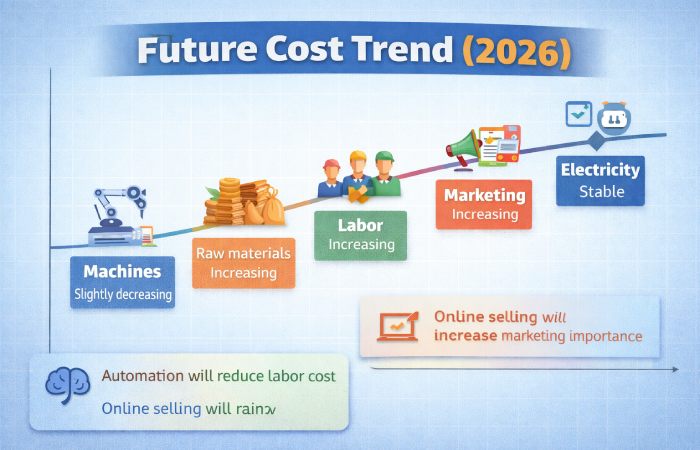
Simple Explanation of the Curve
This chart shows how different costs will change in the future.
- Machines cost decreasing
Machines are becoming cheaper due to better technology and competition. - Raw materials increasing
Prices are rising because of demand and supply changes. - Labor cost increasing
Worker salaries are increasing every year. - Marketing cost increasing
Online marketing and ads are becoming more important and competitive. - Electricity stable
Power cost is not changing much compared to other expenses.
Refer to the India manufacturing growth report for detailed industry trends.
Real Insight
- Automation will reduce labor dependency in the future
- Online selling will make marketing more important
Final Advice
Don’t focus only on total cost.
Focus on:
- where to spend
- where to save
A smart business is not the one that spends more.
It is the one that manages money better.
Final Thoughts
Starting a manufacturing business is possible even with small investment.
The key is:
- proper planning
- controlled spending
- continuous improvement
If you manage your cost well, profit will come automatically.