

Introduction
Intraday trading is buying and selling stocks within the same trading day. Unlike long-term investing, intraday trading focuses on short-term price movements. For beginners, intraday trading can be exciting, but it requires a strong strategy, discipline, and risk management.
The goal of this guide is to provide a step-by-step approach to help beginners understand, plan, and execute trades successfully. This article also includes practical examples, tables, and tips for managing risk effectively.
Why Intraday Trading?
Intraday trading allows traders to capitalize on short-term market fluctuations. It is popular in India and globally because it provides opportunities to earn daily profits without holding long-term positions. However, it is riskier than long-term investing due to sudden price swings. Beginners must understand key concepts, use reliable strategies, and follow a strict plan.
| Feature | Intraday Trading | Long-Term Investing |
| Holding Period | Same day | Months/Years |
| Risk | High | Medium/Low |
| Capital Needed | Low/Medium | Medium/High |
| Potential Returns | Quick, small | Slower, larger |
Key Terms Every Beginner Must Know
Before you start trading, it’s important to understand some basic terms:
| Term | Meaning |
| Buy | Purchasing a stock expecting its price to rise. |
| Sell | Selling a stock you own to book profits or cut losses. |
| Stop-Loss | Pre-determined price to exit a trade if the market moves against you. |
| Target Price | Price at which you plan to exit for profit. |
| Market Order | Buying/selling at the current market price. |
| Limit Order | Buying/selling at a specific price or better. |
Top Technical Indicators for Beginners
| Indicator | Purpose | How it Helps |
| RSI | Overbought/Oversold | Shows if stock is likely to reverse |
| MACD | Trend direction | Helps identify entry/exit points |
| EMA | Average price trend | Smooths price data for trend analysis |
| Bollinger Bands | Volatility | Helps set stop-loss/target |
| Volume | Trading activity | Confirms price moves |
To learn how these indicators work on real charts, see the tutorial on StockCharts: Step-by-Step Intraday Trading Strategy
Step 1: Pre-Market Analysis
- Check global market trends (e.g., US & European markets) to understand market sentiment. Reliable sources like Investopedia provide guidance for beginners. You can also get insights from our guide on emerging market growth in 2025 to understand global trends better.
- Look at overnight news that might affect sectors.
- Identify stocks with high volume in the previous session.
Step 2: Stock Selection
- Focus on liquid stocks (high trading volume).
- Look for volatile stocks that move 2–5% per day.
- Avoid stocks with very low liquidity to prevent slippage. Beginners can also check our guide on best stocks for beginners with little money to start safely.
| Stock Symbol | Volume (Millions) | Daily Movement (%) | Sector |
| ABC | 5 | 3.2 | Banking |
| XYZ | 8 | 4.5 | IT |
Step 3: Identifying Entry Points
- Use technical indicators like RSI, MACD, and EMA.
- Look for support and resistance levels.
- Monitor candlestick patterns like Doji, Hammer, and Engulfing.
Example Scenario:
Imagine stock ABC opens at ₹100. Previous day’s high was ₹102, low ₹98. Using RSI and EMA, you notice it is near support (₹99) and RSI = 35 (oversold). This indicates a potential buy opportunity.
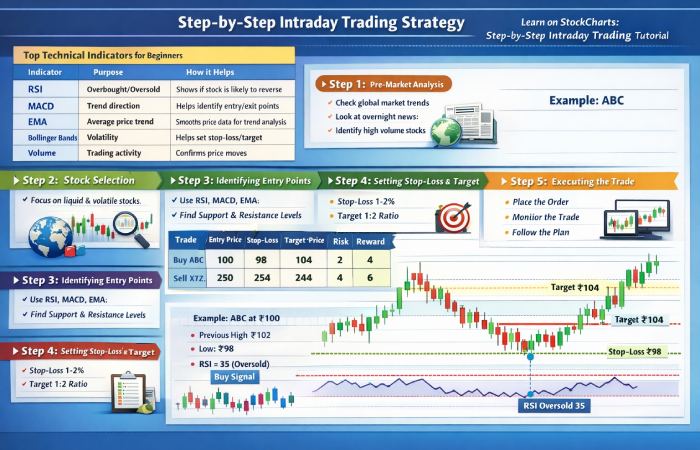
Step 4: Setting Stop-Loss and Target
- Always set stop-loss to limit loss (1-2% of capital).
- Set a target based on risk-reward ratio (1:2 is ideal).
| Trade | Entry Price | Stop-Loss | Target Price | Risk | Reward |
| Buy ABC | 100 | 98 | 104 | 2 | 4 |
| Sell XYZ | 250 | 254 | 244 | 4 | 6 |
Step 5: Executing the Trade
- Use reliable trading platforms.
- Stick to your strategy and avoid emotional trading.
- Monitor the stock continuously until you hit your target or stop-loss.
Step 6: Closing the Trade
- Exit the trade exactly at the target or stop-loss.
- Avoid holding overnight unless you have a swing trading strategy.
- Record your trade for review and learning.
Tools and Platforms
Beginners should use platforms that provide:
- Live charts
- Technical indicators
- Fast execution
If you’re new, you can learn how to start investing with small money for practice.”
| Platform | Features | Suitable For |
| Zerodha Kite | Interactive charts, multiple indicators | Beginners & Professionals |
| Upstox Pro | Real-time data, alerts | Beginners |
| Angel Broking | User-friendly, research tips | Beginners |
Platform Comparisons:
| Platform | Free Features | Paid Features |
| Zerodha | Charts, Orders | Advanced indicators |
| Upstox | Orders, Alerts | Pro charts, historical data |
| Angel Broking | Basic charts | Expert analysis & tips |
Common Mistakes Beginners Make
| Mistake | How to Avoid |
| Overtrading | Limit to 2-3 trades per day. |
| Ignoring risk management | Always set stop-loss and position size. |
| Emotional trading | Follow a strict trading plan. |
| Chasing losses | Take a break if you lose consecutively. |
Scenario Example:
Ramesh invested ₹50,000 in one stock without stop-loss and lost ₹10,000 in one trade. A small position with proper stop-loss could have limited losses to ₹500–₹1,000.
Risk Management Techniques
| Technique | Explanation |
| Position Sizing | Only invest 1-2% of capital per trade. |
| Stop-Loss Orders | Automatically exit losing trades. |
| Diversification | Avoid putting all money in one stock. |
| Risk-Reward Ratio | Aim for trades with higher reward than risk. |
Sample Risk Table:
| Trade Capital | Risk % | Amount at Risk | Potential Profit |
| 50,000 | 1% | 500 | 1,500 |
| 50,000 | 2% | 1,000 | 3,000 |
| 50,000 | 3% | 1,500 | 4,500 |
Tip: Avoid emotional decisions. Stick to planned risk limits.
Sample Intraday Trading Plan
| Time | Activity |
| 9:00 AM | Market pre-check, news scan |
| 9:15 AM | Identify top 5 stocks to watch |
| 9:30 AM | First trade execution |
| 11:00 AM | Review positions, adjust stop-loss if needed |
| 1:00 PM | Second trade execution |
| 3:15 PM | Close all trades, record results |
Example Trade Plan:
| Time | Activity | Stock | Entry | Exit | Notes |
| 9:15 | First Trade | ABC | 99 | 102 | Followed trend |
| 10:30 | Second Trade | XYZ | 249 | 253 | Strong momentum |
Frequently Asked Questions (FAQs)
Q1: How much capital is needed for intraday trading?
A1: Beginners can start with 50,000–100,000 INR or equivalent in other currencies. Focus on risk management, not size.
Q2: Can beginners make profits daily?
A2: Profits are possible but not guaranteed. Consistency comes with discipline and learning.
Q3: Difference between intraday trading and swing trading?
A3: Intraday trading closes all trades by end of day. Swing trading holds trades for several days to weeks.
Q4: Which platform is best for beginners?
A4: Zerodha Kite and Upstox Pro are beginner-friendly, offering live charts, indicators, and alerts.
Q5: How to set stop-loss effectively?
A5: Calculate 1-2% of capital per trade and set stop-loss accordingly. Stick to it.
Q6: How much risk is acceptable per trade?
A6: Beginners should risk no more than 1-2% of total capital on a single trade.
Q7: Are intraday trades taxable?
A7: es, profits are taxable as per short-term capital gains tax in India. For beginners, it’s wise to start investing with small money to understand the system and manage risk.
Q8: Can I practice without losing money?
A8: Yes, virtual trading platforms allow practice using virtual capital.es, profits are taxable as per short-term capital gains tax in India. For beginners, it’s wise to start investing with small money to understand the system and manage risk.
Q9: How many trades per day are optimal?
A9: 2–3 trades are sufficient for beginners; avoid overtrading.
Q10: How to manage losses psychologically?
A10: Accept small losses as part of trading. Take breaks, avoid revenge trading.
Conclusion
Intraday trading can be profitable if approached with discipline, research, and a solid strategy. Beginners should focus on learning, practicing with small positions, and maintaining a trading journal. Avoid chasing profits or getting emotional — success comes with patience and strategy adherence.
Key Takeaways:
- Use stop-loss and target levels for every trade.
- Stick to 1-2% risk per trade.
- Select liquid and volatile stocks.
- Monitor charts and indicators before entering trades.
- Keep a daily trading journal for review and improvement.
By following this step-by-step intraday trading strategy, beginners can gradually build confidence and skill while minimizing risk.