
Introduction
Emerging markets are countries with rapid economic growth, expanding industries, and rising consumer demand. They play an increasingly important role in the global economy — growing faster than developed nations and creating new business, investment, and job opportunities. According to global forecasts, emerging markets are expected to grow nearly twice as fast as advanced economies in 2025, making them powerful engines of economic expansion.
What Are Emerging Markets?
Emerging markets are economies transitioning from low-income to middle- or high-income status. These countries typically:
- Grow faster than developed economies
- Have increasing consumer demand
- See rapid industrialization and urbanization
- Attract foreign investments
Examples include India, Vietnam, Philippines, Bangladesh, Mozambique, Rwanda, and Guyana. Some of these are projected to grow at annual rates above 6-7% over the next five years, far exceeding rates in developed markets.
Note: Emerging markets are not a single group — growth varies widely by country and sector.
Growth Trends by Region (GDP Forecast Through 2025)
| Region | Forecast GDP Growth (%) |
| Emerging Asia | 4.80% |
| India | 6.50% |
| Sub-Saharan Africa | 4.10% |
| Middle East & North Africa | 4.20% |
| Latin America & Caribbean | 2.50% |
| World (Global Average) | 3.00% |
| Advanced Economies | ~1.8% |
India and much of Asia will grow faster than the rest of the world, creating opportunities across industries.
Emerging vs Developed Growth Line Chart
| Data to Show (Example Projection 2023–2030) | ||
| Year | Emerging Markets (%) | Advanced Economies (%) |
| 2023 | 4.2 | 1.7 |
| 2024 | 4.5 | 1.8 |
| 2025 | 4.8 | 1.8 |
| 2026 | 4.7 | 1.9 |
| 2027 | 4.6 | 2 |
| 2028 | 4.5 | 2 |
| 2029 | 4.4 | 2.1 |
| 2030 | 4.3 | 2.1 |
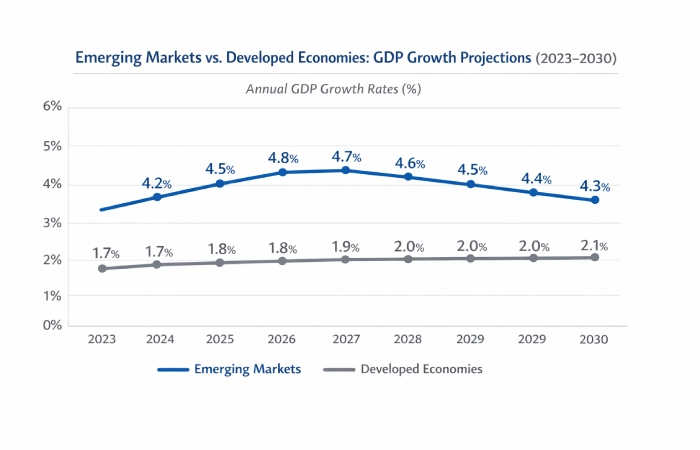 The chart clearly shows that emerging markets are projected to grow nearly twice as fast as advanced economies through 2030. While developed nations face slower population growth and mature industries, emerging economies benefit from expanding labor forces, infrastructure investment, and rising domestic consumption.
This consistent growth premium creates long-term investment opportunities in equities, infrastructure projects, and digital industries. However, higher returns often come with higher volatility, making country selection and sector diversification important.
Why Emerging Markets Are Growing
Demographic Advantage
Many emerging markets have young populations and expanding labor forces. This fuels demand for:
- Housing
- Consumer goods
- Education
- Healthcare
As more people enter the workforce, production and consumption rise.
Urbanization & Infrastructure
Countries such as Vietnam and Nigeria are rapidly urbanizing, increasing demand for transport, electricity, broadband, and housing.
Digital Adoption
Mobile internet penetration is soaring — in some countries more than 60% of internet traffic is on mobile devices — making digital services (fintech, ecommerce, mobile payments) huge opportunities.
Mobile Internet Penetration Growth Curve
| Year | Mobile Internet Usage (%) |
| 2014 | 32% |
| 2016 | 41% |
| 2018 | 52% |
| 2020 | 63% |
| 2022 | 69% |
| 2024 | 73% |
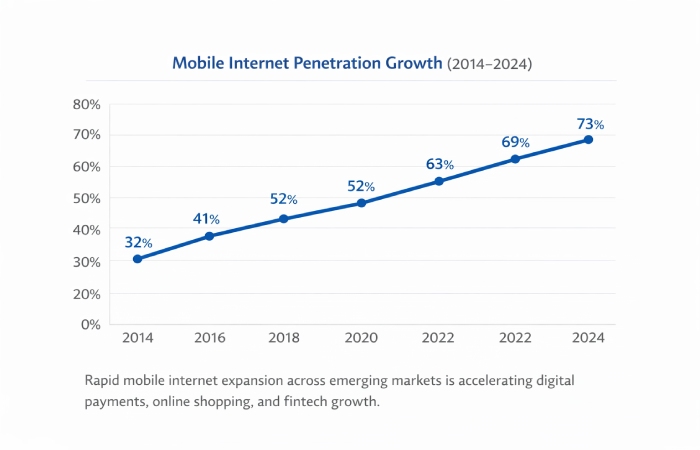
The steady rise in mobile internet usage from 32% in 2014 to 73% in 2024 highlights the digital transformation underway in emerging markets. Unlike developed nations that built desktop-first ecosystems, many emerging economies are mobile-first.
This shift enables:
• Digital banking without physical branches
• E-commerce growth without traditional retail networks
• Online education access in rural areas
• App-based gig economy expansion
Mobile infrastructure reduces entry barriers for startups and accelerates innovation across fintech, healthcare, and logistics.
Middle Class Growth
Rising incomes mean more demand for:
- Consumer goods
- Banking and financial products
- Healthcare services
- Travel and leisure
Top Sectors With Growth Potential
Below are high-potential sectors supported by expert research and forecasts:
Sector Growth (Projected CAGR 2025–2030)
| Sector | Projected CAGR | Key Driver |
| Fintech | 23.50% | Financial inclusion |
| E-commerce | 21.70% | Middle class & internet adoption |
| EdTech | 19.40% | Youth population & learning demand |
| Renewable energy | 18.20% | Climate policy & energy needs |
| Healthcare tech | 16.80% | Aging & access gaps |
High-Opportunity Countries – Comparison (2025–26 Outlook)
| Country | Forecast GDP Growth | Main Growth Driver | Key Strength | Risk Level (General) |
| India | 6.4% – 6.7% | Domestic demand, services, tech | Large population, strong IT sector, digital economy | Medium |
| Philippines | ~6% | Services & remittances | Young workforce, consumption growth | Medium |
| Vietnam | ~6% – 6.5% | Manufacturing & exports | Electronics hub, supply chain shift | Low–Medium |
| Guyana | 20%+ (oil-driven) | Oil production | Fastest GDP expansion globally | High (oil dependence) |
According to the International Monetary Fund (IMF) World Economic Outlook 2025, emerging economies such as India, the Philippines, and Vietnam are expected to maintain strong growth momentum through 2025–26.
Simple Growth Comparison
| Country | Economy Type | Export Focus | Digital Growth | Infrastructure Growth |
| India | Mixed economy | Services, IT, Pharma | Very High | High |
| Philippines | Service-led | BPO, remittances | High | Moderate |
| Vietnam | Export-led | Electronics, textiles | High | High |
| Guyana | Resource-based | Oil & energy | Moderate | Very High (oil projects) |
Investment Themes & Opportunities
a) Digital & Mobile Technology
- Mobile adoption fuels:
- Fintech solutions
- Mobile commerce
- Online education
- Digital payments
Investors can focus on companies leading mobile penetration and digital services.
b) Renewable Energy
With rising energy demand, emerging markets are building renewable infrastructure. This supports:
- Solar & wind projects
- Battery manufactures
- Smart grid systems
Investments here align with global climate commitments.
c) Manufacturing & Nearshoring
Manufacturers are relocating supply chains from China to countries like:
- Vietnam
- Mexico
- India
This boosts production, FDI, and export growth.
d) Financial Services & Fintech
Banks, mobile wallets, and digital lenders can expand where financial inclusion is increasing.
Risks & Challenges
Emerging markets also have risks:
-
Political instability
-
Currency volatility
-
Regulatory uncertainty
-
Debt sustainability
For example, inflation and fiscal policies can fluctuate widely, impacting investment returns.
However, long-term growth prospects remain strong if these risks are managed.
FAQ
Q1: Why do emerging markets grow faster than developed economies?
Because of younger populations, urbanization, industrial expansion, and rising domestic demand.
Q2: Which emerging market will grow fastest in 2025?
India and Guyana are expected to lead growth rates.
Q3: Are emerging markets risky investments?
Yes, they offer higher returns but also higher volatility.
Q4: What sectors have the highest growth potential?
Fintech, renewable energy, e-commerce, and healthcare technology.
Conclusion:
Emerging markets are driving global economic growth, expanding nearly twice as fast as advanced economies. Rising digital adoption, urbanization, and young populations are creating strong opportunities across technology, infrastructure, and financial services.
While risks such as volatility and policy changes remain, the long-term outlook is positive, positioning emerging markets as key engines of global expansion through 2030 and beyond.